
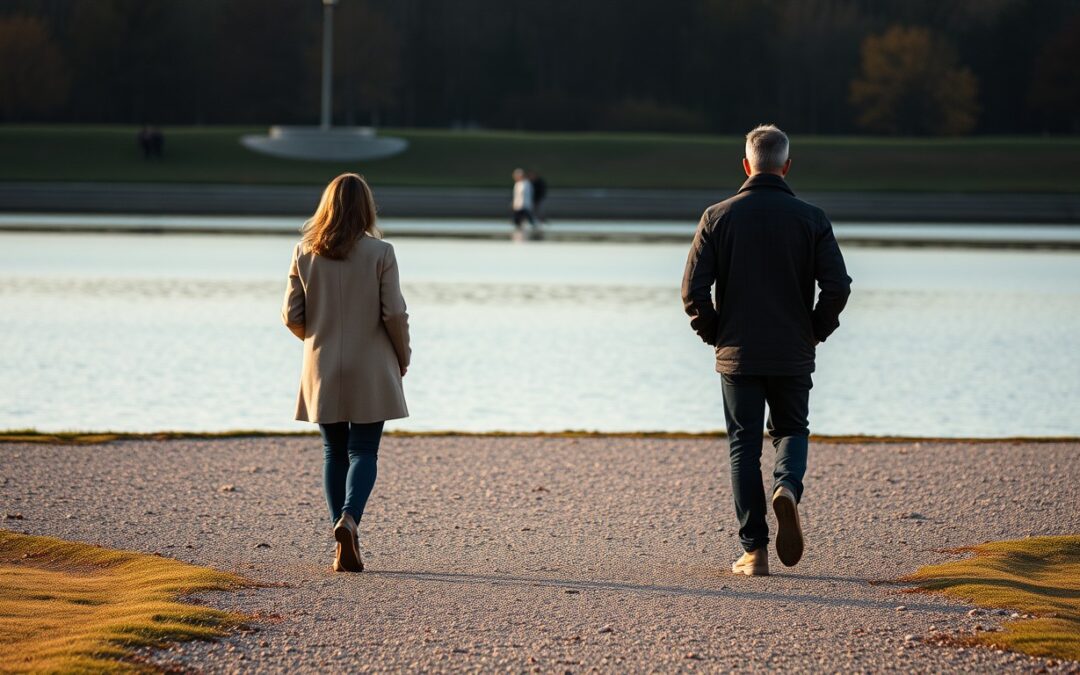
Think back to the last time you got clear on something that had been bothering you for days. Where were you? For many people, the answer is not at a desk. It is on a walk, in the shower, cycling home. Somewhere the body was moving, and the mind was finally free to wander.
Ingrid knows that feeling well. A finance controller from Oslo, she moved to Hamburg three years ago and was now weighing whether to stay in her role or take an offer in Amsterdam. For weeks, she had made lists at her desk and talked it through over coffee. Every conversation ended in the same loop. The clearest thought she had all month came on a Saturday walk along the water, and it surprised her.
That is the idea behind walk-and-talk coaching: instead of sitting across from each other in a room or through a computer screen, we walk side by side while we talk. It sounds simple. For many people, it changes the whole conversation.
So, what does a session actually look like?
What walk-and-talk coaching is
A walk-and-talk session is a regular coaching session held outdoors while walking. We choose a route, usually a park, a path by the water, or a quiet green street, and walk at an easy pace. The structure of the session remains the same: we look at what is going on, what you want, and what your next step is. Only the setting changes.
It may sound like a small change. The research suggests it is not.
Why walking helps you think
Movement boosts creative thinking. In a well-known study at Stanford University, people’s creative output increased by an average of 60 percent while walking compared to sitting, and the effect lasted for a while after they sat down again. Walking helped most with generating ideas and seeing new options, rather than with tasks that have one right answer. That is exactly what most coaching conversations need: not the one correct solution, but new ways of looking at your situation.
Side by side feels safer than face to face. Sitting opposite someone can feel like an interview. Walking next to each other takes away the pressure of constant eye contact. Many people find it easier to say difficult things when they are looking at the path ahead instead of at another person.
Nature calms an overactive mind. In another Stanford study, people who took a 90-minute walk in a natural setting reported less rumination, the repetitive negative thinking that keeps us stuck, and showed less activity in a brain region linked to it. People who walked the same distance along a busy road showed no such change. That is why I choose green, quiet routes. A calmer brain thinks more clearly, which is why stilling the mind is the first step of my Inner Clarity Method™. On a walk, part of that happens naturally.
The body joins the conversation. Stuck thoughts often come with a stuck body: shallow breathing, tense shoulders, sitting still for hours. Moving gives that tension somewhere to go.
Moving forward, literally. Walking toward somewhere makes it easier to think about moving forward in your life. People often notice that their language changes during a walk, from “I can’t” to “what if.”
Ingrid noticed it in her first session. Twenty minutes in, looking at the path rather than at me, she said something she hadn’t said out loud before: the Amsterdam offer wasn’t about the job. It was about not wanting to start over again. Once that was said, the real conversation could begin.
Walking works for many people, but it suits some especially well.
Who it suits
Walk-and-talk coaching works especially well if you:
- think better while moving than while sitting still
- find intense eye contact uncomfortable when talking about personal things
- spend most of your day behind a screen
- feel stuck, restless, or overloaded with thoughts
- want coaching to feel less like an appointment and more like a conversation
It is also a good fit for managers and teams. In fact, that is where my walk-and-talk coaching began. During a wellness week at my corporate job in Amsterdam, I had to be creative because resources were limited. I had lunchtime walks with colleagues from different departments. People who rarely crossed paths at work suddenly had time to really talk, and departments connected better and reached out to each other much faster than before. As one colleague put it: “This is a very nice way to get to know each other.” Some people kept the lunch walks going for months after the wellness week ended. The idea stayed with me. A walk in pairs turned out to be one of the simplest ways to have an honest conversation at work, and it became the starting point for how I coach today.
Of course, a walk raises a few practical questions.
What to expect: pace, privacy, and weather
A session lasts 60-90 minutes, at an easy pace. It is not a workout: we can pause, sit on a bench, or slow down whenever you like. If walking is difficult for you, we can adapt the route or work seated outdoors or online.
We choose quiet routes where you can talk freely. If someone passes, the conversation pauses naturally, just as it would anywhere else. Rain or cold does not have to stop us: with the right clothes, a walk in grey weather can be surprisingly clearing. And if the weather really does not cooperate, we can always move indoors or online.
Ingrid’s third session took place in steady Hamburg drizzle. She arrived in a raincoat, laughing that it was the most Hamburg thing she had ever done. By the end of that walk, she had made her decision: she would stay and ask for the role she wanted. She did, and she got it.
Walk-and-talk with me
I offer walk-and-talk coaching in English for internationals and professionals who want to think in motion: in person around the Alster in Hamburg, or by phone anywhere in Germany, the Netherlands, or beyond, where you walk wherever you are and we talk as you go. By phone, you keep the two things that matter most: you are moving, and there is no eye contact to manage. If you prefer to work online, I may even suggest you take part in a session for a walk on your own, with a question to think about along the way. Everything discussed is confidential. If I ever share a client story, it is anonymized, the details are changed, and it is only with your permission.
I know how much clearer life can look from a path than from behind a screen, especially when you are still finding your place in a new country. Curious whether walking might unlock something for you? Book a free 30-minute discovery call, and we will see if a walk-and-talk session fits what you are working on.